Blogging Reflection

Blogging was a new concept for me, I’ve always avoided having a blog or posting my thoughts on the internet in general. But having a blog has been a lot more fun than writing weekly reflection papers on what we’ve been doing in class, so I appreciate it for that. It also has allowed for me to get a little more familiar with the whole idea of blogging, I don’t see myself ever having a personal blog but I do see myself using blogging in my future classroom, whether just for a unit or even for a whole semester. But I definitely think teachers need to take the time to learn about blogging and how to go about blogging in a classroom, even if it’s just internet research-there are a lot of resources out there- I found this one on what to know before teachers start blogging to be very helpful. I really enjoyed the relaxed tone in blogging rather than trying to sound overly academic. Just the environment of ‘blogs’ changed the way I wrote, but yet it still conveyed the same message and the same content as if I were reflecting in a more ‘academic’ way just without the stuffy-ness and without trying to sound super intelligent.

For my blog with the most ‘professionalism’ I chose my first blog post, Technology’s Place in Education. I felt this was my most formal piece while also adding a lot of my input into it, but the structure and the read of it seemed much more professional than some of my other blog posts. I maintained consistent organization, references, and added a lot of my views and opinions in a very informational way.

For design I chose my blog post titled Mini Multimodal Composition. I chose this one because it was my only blog post where I had more than one visual, and I placed my infographic within the structure of my blog post, rather than just having the images at the top like the rest of my posts. I integrated it into my explanation so that it’s placement made the most sense and the supporting information surrounded it.

My most creative blog post, besides my multi modal composition, was my Writing Coach Profile. Mostly because rather than being focused around course content it was focused on me, my writing experiences, and what I felt being a writing coach was all about. Not that that sounds all too creative but it took the most creative thinking to come up with the content rather than basing it around course content and our readings and lessons.

For the peoples choice award category for my own blog I would have to say that my post on My Writing Process. I chose this one because it is the post with the most voice and is very representative of my entire educational career and my future as a writer. Writing is part of what made me realize that I wanted to be an educator and it is also part of what made me realize that I loved English, so this post is the most reflective of me.

The classmate who I nominate for the people’s choice award would be Kayleigh. I loved the way she organized her entire blog and even the structure of her individual blog posts. I also liked that she included more than what was required, like adding more than one image, or a music video/song that could be discussed, and that her titles were more than just rewording the required blog post from the syllabus. The use of videos made reading her blogs a lot more interesting and her voice showed through on all of her blog posts. Overall I enjoyed reading/looking at her blog posts throughout the semester, which is the main reason I nominated her.

Mini Multimodal Composition

Multimodal projects give students the opportunity to express themselves on a platform that fosters creativity and uniqueness. There are also so many ways to utilize multimodal projects, anywhere from a quick in class exercise to a unit long composition process, the opportunities are endless.

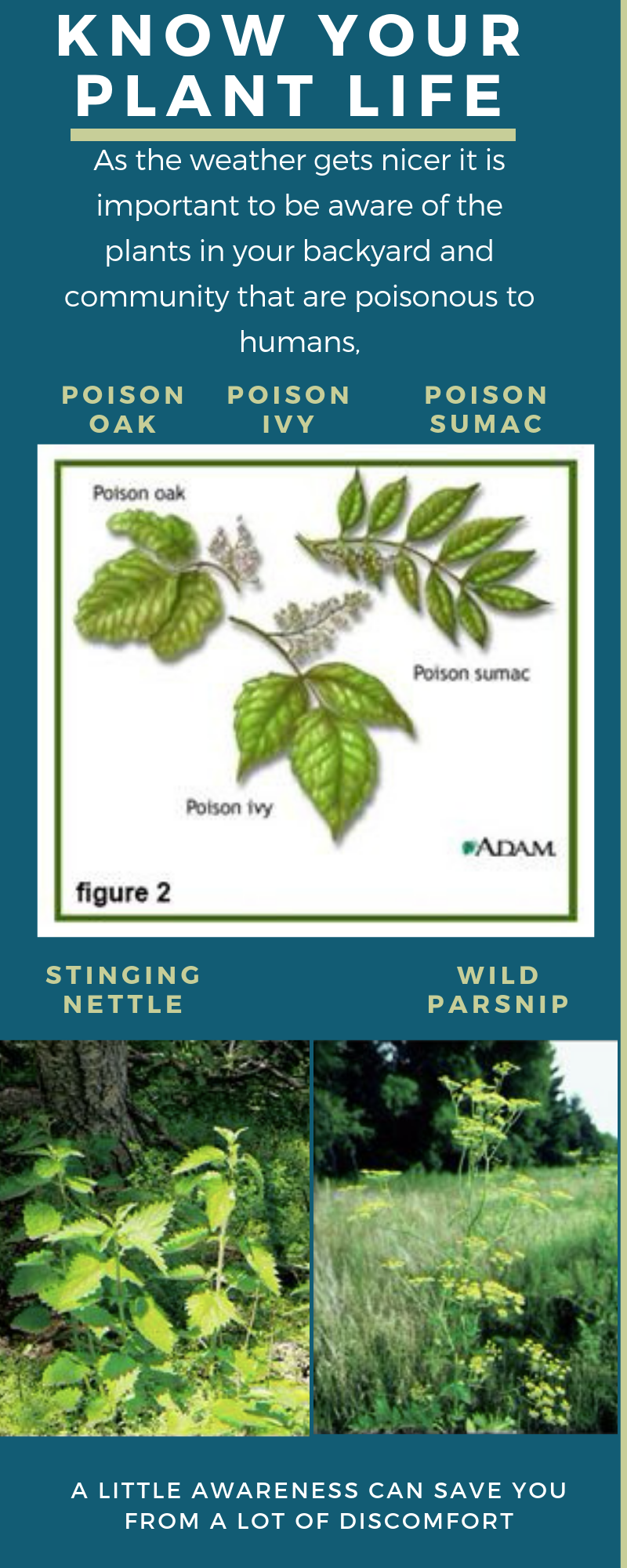
I did a short and simple infographic on the importance of plant awareness. I went back and forth on whether to do an ‘English content’ related infographic or not, and I ended on plant life since I used to spend far too much time slathering on calamine lotion after being under educated on what plants I should avoid, and I think it is a simple but often neglected lesson for anyone who spends time outdoors.

I didn’t incorporate any audio or video, but I felt that for the purpose of my intended message the pictures were more than adequate. People often recognize the names of poisonous plants but not the actual plant, so for this particular use, the pictures are almost more important than the words. When finding images I had to pick ones that depicted the plants I wanted to use in a clear way. I made the choice to include poison sumac only because that was the best image I could find that clearly compared poison oak and poison ivy, the others were either too blurry or too big to fit on my project. And while poison sumac is only found in certain ecosystems in Wisconsin, such as the Cedarburg Bog and similar permanent wetlands, I felt it was worth adding to the infographic for use of the image itself since the other two are so commonly found.

I struggled with sizing, I wanted the overall infographic template to be bigger, but I couldn’t figure out how to increase the size on the platform I was using (I don’t think you could change template sizes), so I had to work with what I had. And in order to do so I had to choose what I thought was the most common and easily avoidable poisonous plants-since there are many more in Wisconsin. I also had a hard time figuring out how to size the images, I didn’t want them to be too big that they seemed to take up the whole infographic, but I wanted them to be big enough to at least be able to identify the plants. So throughout my process it was a lot of resizing and moving of text and images. I also was aware of color choices, which seems like an unimportant or mundane thing, but since I didn’t want to take away from the text by choosing clashing or uneasy to read colors I had to be conscientious of these choices.

Through this seemingly simple process I was able to prioritize, experiment, and even just educate myself on the platform I was using. It also gave me a better idea of what exactly an infographic is and to focus on important information rather than overloading information so it isn’t cluttered or loses the focus of the ‘big idea’.

Originally I had this idea in my head that infographics were used to show statistics or comparisons, but then I read in the article What is an Infographic? that you should use infographics “when you need to give someone a really quick rundown on something that can be hard to explain in words alone” (Midori Nediger). Which is why I felt that something that NEEDS visuals, like poisonous plants, would be a good use of an infographic.

Infographics or any multimodal composition can teach students to use resources appropriately, build organization skills, learn how to prioritize, and can even give them a way to address a community or societal issue in a way that doesn’t directly link them to it-if they would prefer to stay anonymous. These platforms can give students a place to find their voice aside from academic papers and formal projects.

Multimodal Composition

I have little experience with multimodal composition, the high school I went to didn’t exactly embrace technology, most of the teachers preferred avoiding multimodal projects in their classroom, I think part of this could be because they didn’t want to have to learn how to use these platforms. There have been only few times I’ve done a presentation that wasn’t a PowerPoint. In Chemistry, we had to make a music video about our topic (it did not turn out good, as you can probably imagine with a scientific music video). In my advertising class we had to make an informative commercial to get students and faculty to come to our ‘Think Pink’ breast cancer fundraising Volleyball game, which was also kind of cringe-y since we had little to no guidance or background information on making a digital piece. And in a Freshman English class where we had to make a video acting out and reading the poem O Captain! My Captain! which turned out a bit ridiculous because we just stuck a canoe in the shallow river in my parents’ backyard and pretended to row along until we reached the shore and you could hear my dad cutting the grass and my dog barking in the background. So all three of my ‘multimodal’ projects did not turn out as I imagined they would.

After reading a bit more about digital composition methods I think two that I would use in a future classroom would be a podcast on a book, and a mini documentary on an influential person in your life (or maybe an influential experience). I chose a podcast because I think this can be a fun way to informally explore thoughts and ideas on a book with the intention of a listening audience while not having to be face to face. But as Hicks, Turner, and Statton point out in the piece Reimagining Writing Process via Digital Storytelling, it can move a student out of their comfort zone, which I believe, in return can broaden their idea of their education and the modes in which they can present their knowledge on what they’ve learned and explored. If my teachers never made digital composition a part of my classroom experience, I would have never thought to present my projects in this way, and would have this mindset that if I read a book the only option is to write a paper to present my thoughts and reflections. The article also mentions the extra help that one student needed, which isn’t a bad thing-it can show students that it is okay to go to teachers with help on new topics-we can’t expect our students to know everything-so we should encourage them to ask for help with exploring digital composition. I think a mini documentary would be a good way for students to show their artistic side while also showing that they know how to be informative and supply the audience with information that will develop into a greater picture. By figuring out how to organize, compose, and edit a piece like this students can use deductive reasoning to figure out what would make their piece the most affective-not to mention it will show students that there doesn’t just have to be one draft-it could take edit after edit after edit to get it just the way they want.

In the piece Reimagining Writing Process via Digital Storytelling the authors wrote; “We must help the teachers with whom we work to develop their own knowledge, even as they consider how to help their students grow as writers. And, as we have considered the nature of knowledge that writers need in a digital world, we have shifted our teaching to include both traditional writing assignments such as personal narratives and argumentative essays, as well as digital writing pieces” (Hicks, Turner & Stratton, pg. 168). I think it is especially important to note that as teachers we need to help each other explore and learn about the digital world and how we can implement this into our classrooms so our students can grow and develop in ways that the internet and technology now allow so readily. This article from the Huffington Post gives 8 ways for teachers to use technology to engage their students and help ease them into ‘difficult to grasp’ concepts.

Writing Coach

The experience of being an ‘online’ writing coach has been both extremely useful and also a little difficult. I tend to be a person who over-explains, so to have to write my comments in the margins without ever interacting face to face with these students was hard for me. I would feel like I need to give an example of what I am saying some of the time, while other times I would make sure to write ‘this is just a suggestion’, because I didn’t want it to come off as me just telling them it shouldn’t be there or I think something else would benefit more. Never meeting these students made it a little more challenging to just be blunt about what I think they could add or change because I don’t know them and they don’t know me-so why would they want to listen to my suggestions? I understand that was the point of this, and the students seemed eager to get feedback, but some of the poetry was very personal and to give my suggestions almost felt like an invasion of privacy.

This website with 5 Tips for Giving Constructive Feedback to a Writer seemed to ease some of my weariness about what I should and shouldn’t do. For one, I felt like I needed to explain myself for everything or they might not understand it. So when I would mention that maybe they could use a metaphor, I would give an example of an unrelated metaphor. In the article they gave the example of, “Which YouTube video would you rather watch: Someone describing how to play guitar, or someone holding a guitar and demonstrating each chord? The latter, right?” So instead of just saying add this or change that, sometimes (not all the time) I would give an example or deeper thought about why I felt they could change it to strengthen their work. But I also mentioned at the end these are just suggestions and they might want to test out different things throughout their paper, because you can never have too many drafts.

With the students from the Hmong American Peace Academy, for one of my students it seemed as though English wasn’t their first language, or their most spoken language, so it made giving comments a little more difficult. As mentioned in the reading Tutoring ESL Students: Issues and Options, Harris and Silva say, “tutors need to distinguish between errors that will interfere with the indeed reader’s understanding of the text (global errors) and those that will not (local errors) and to give Priority to the former” (Harris and Silva, pg. 526). I an so used to editing for both content, grammar, and spelling when I help my friends edit their paper, so to give priority to global errors rather than local errors felt strange to me, but I also didn’t want to bombard them with all these suggestions so I tried to stick to this idea. I think that correcting for grammar and other local errors would be more for the teacher to address rather than me as a writing coach. Since I don’t know the student, and I don’t know to what level or degree they speak and write English I didn’t see myself in a place to address these issues, perhaps I would have felt different if I knew the student more.

I think that because the teachers and peers know these students better, that they understand the way the talk and write more than I ever could. I don’t know how they present themselves in the classroom, all I know is what they wrote in their poetry and papers, so I think that their peers and teacher would have more of an influence on the voice of their writing. I was more than willing to give suggestions and ideas on where I though they could elaborate or expand on their ideas, but I never suggested they take something out or change it completely, that wasn’t my call to make. However, I think getting feedback from a writing coach, teacher, and peers would help students to get a more well rounded idea of where to go with their revision process. Sometimes it is hard to take a step back from what you wrote and look at your work with fresh eyes, so feedback from people in different positions can really get the wheels turning on where your work can be expanded and tweaked.

My Writing Process

My writing process is constantly changing as I get older and as I have less “guidelines” in my assignments. When I was in high school we would nearly always have to turn in something resembling prewriting/brainstorming, then a rough draft with either peer edits, personal edits, or both, and then turn in the final draft. I have never been a big fan of prewriting, I almost never take the time to write out my ideas and how I want to structure them. As the Flower and Hayes article said, “the writers frequently appear to be working under a high-level goal or plan to explore: that is, to think the topic over, to jot ideas down, or to just start writing to see what they have to say” (Flower and Hayes, pg. 382). I prefer to start writing and see what I have to say, while I’m writing if I think of something that will fit better in a different place or later on in my paper I will write it at the bottom of the document and come back to it when I get to an appropriate point, or come back at the end and find where it fits best. As the text said, “Writing processes may be viewed as the writer’s tool kit. In using the tools, the writer is not constrained to use them in a fixed order or in stages” (Flowers and Hayes, pg. 376). This helped me to view the writing process as less structured than my teachers tried to make it, which works better for me. I was so wired when I got to college that I should be prewriting that when I would write papers I would feel like I was skipping a step, but I “pre-write” while I write, in the sense that I write down ideas as I go, and this reading helped me understand that there is nothing wrong with that.

I don’t believe this is the only way to write, it is just how I write. So I think students and other writers, especially new writers should try different methods to figure out what works best for them. Because of this I don’t know if I would require my students to turn in a ‘brainstorming page’ or a different kind of pre-writing activity. If it helps them of course I will encourage students to brainstorm and organize prior to writing, but I won’t force them to.

I’ve been writing for longer than I can remember, so I realize that my writing process is extremely different now as opposed to when I was in middle school when I was a newer writer. So I understand that writing can be difficult to a new writer and my technique of just writing and seeing what flows might not work for a new writer, it took me time to get where I am as a writer. My papers used to be so disorganized because of the random ideas and things I would recall as I write so it was a lot of editing. Now I’ve figured out how to do this without making such a mess, but it took time, so it is very unlikely that a new writer would understand my personal writing style. This blog includes 6 ways to improve your writing, which won’t necessarily work for everyone but it could spark some ideas to experiment with.

The only way I see my writing style changing as I write in an online setting is that I am less ‘formal’, I leave my academic voice behind for a more casual feel. However, that doesn’t mean I lack grammar, punctuation, and a clear message. When I am on social media I tend to leave out more punctuation, but I typically don’t write any differently than I would for this blog post.

Writing Coach Profile

Hi all! My name is Melissa and I am studying to become an English teacher. Despite what my friends and family have been telling me most my late teenage to adult life, it took me a while to realize that teaching is what I am passionate about and want to do for the rest of my life, so now I am as anxious as ever to begin my career. For as long as I can remember English has always been my favorite subject, I love literature and writing papers about what I read and what my interpretation of texts, but I don’t see myself as a ‘professional writer’. I’ve learned that the more I write, the more I learn. Whether that’s learning something new about my own writing ability or learning something completely new about writing and the writing process. I have also always loved school, as tired as I may get some times I love the whole process of learning and gaining knowledge, so I cannot wait to pass that passion onto my own students one day and I hope I can influence students to learn to love education even when it can seem trying at times. Here is a writers digest article about becoming a successful writer, I believe that just knowing what makes a successful writer can bring you one step closer to becoming a successful writer yourself.

I currently tutor Early Literacy to K5 – 3rd graders, and although I don’t help them write papers or essays I am helping them get a basic understanding of reading and writing, which will help to make them into successful writers later in their education. Helping young students grasp the basics and watch them grow as students and writers is extremely rewarding.

I not only love writing papers but editing and revising them as well, so I am looking forward to doing just that in this class. Hopefully I can share what I know and love about writing with students throughout the semester.


Technology’s Place in Education

Social media has been around since I was in middle and high school, however, teachers never utilized any of these digital platforms in my school. If anything, they discouraged the use of these for fear that they would just cause problems; they would block any type of ‘free expression’ forum on the school computers and they would educate us on only the negative sides of social media. They never shifted their viewpoints to see the benefits of using these to educate. I’ve always used sites such as facebook or instagram to simply stay in touch with people who I don’t see often. I rarely post anything meaningful, and I never post my opinion or view about social issues on my page. Part of me thinks this is because of how I was educated on social media when I was in high school when it was becoming such a huge part of our society. I do however, use my social media pages to read articles on different social action people around the country and around the world are taking, but I never participate, but it does help to shape my opinion on certain issues. I have friends who use social media as a platform to try to elicit change in our society, and while I support their doing so I’ve just never found myself drawn into the world of posting my thoughts and feelings online, but I still see the importance in it.

Social media and digital platforms are constantly shifting, the place they are at today is immensely different than where they were 10 years ago. Social issues such as race, gender, religion, politics, and other heavily discussed issues are at the forefront of things discussed and posted about. But with these important posts, articles, and discussions comes a lot of controversy and a lot of disagreements, sometimes making these discussions hostile. There is no denying that digital platforms are a huge part of our society, but how can educators use these appropriately in the classroom?

Potential Issues

I believe that one of the biggest potential issue behind utilizing digital platforms in a classroom is the digital divide that is still so evident in our society. Students in large urban schools don’t always have access to internet or computers and therefore have a hard time adjusting to using these in a classroom. It could take more time to teach them how to type properly or navigate the internet than anticipated, therefore taking away from the use of these digital platforms. School’s can’t always afford to supply enough for every student to use, so that creates a divide between those schools who can afford this luxury and those which cannot, which inevitably creates a divide between these students.

Another potential issue which I feel can make the use of digital platforms difficult would be the boundaries between students and staff. The whole idea behind social media and the various digital platforms we have access to is that you have a place to post what you feel is important, all of your thoughts and opinions that you want out there, and you have the freedom to advocate for what you choose to. But the issue is, how do you use these platforms in a classroom when schools so heavily restrict these sites and practices? In the Haddix and Sealey-Ruiz reading, Haddix talked about her work in suburban schools where students were encouraged to use their phones for literature circles, discussion groups, and other classroom activities and teachers encourage them to use social media and other digital platforms in a way that encourages learning and technology. But then she speaks about how in many urban districts these same things that the suburban school promoted the urban schools police and censor, therefore not at all utilizing them. Some think that digital tools can ‘dumb down’ students developing skills, and rather than learning the ‘old fashioned way’ they can bypass this through the use of technology. Is this a justifiable concern?

Immeasurable Potential

Using these platforms in a classroom not only helps to continue to develop student’s reading and writing skills, but it can also help them to develop a voice. Some may find it easier to post their thoughts and feelings to a digital platform, rather than face to face, this can be a way for introverts to express themselves in an educational environment without the stress of face to face interaction. And since classes would not solely be using digital platforms it would not take away from the day to day classroom interaction, it would just give some students a more comfortable place in interact. Often times in class it is the same students keeping the conversation moving, but in a digital discussion forum it gives everyone a comfortable place to interact.

Using technology in the classroom can also begin preparing students for their futures, whether that is higher education or going right into the job force, chances are they will be using technology and digital platforms, and using them in k-12 education can begin developing the skills that will help them transition easier and succeed in whatever path their future holds. Technology has become so important in our society and it is constantly changing, so getting students comfortable and educated on it at a younger can be life changing for them, so utilizing technology in the classroom goes far beyond just finding new ways to educate and teach students.

In an article titled Rescuing Student Participation Through Digital Platforms, Jaxon explores some of these points and talks about other important reasons that digital platforms can give students a voice in the classroom.

It is clear that social media and other digital platforms have a huge impact and influence on society. So what is holding back some schools and teachers from embracing these digital platforms?